
MEANING, NATURE, AND SCOPE OF ADMINISTRATIVE LAW
In the modern era, the state is no longer just a "police state" concerned only with defence and maintaining law and order. We now live in a Social Welfare State, where the government touches every aspect of our lives—from the food we eat and the air we breathe to the education and healthcare we receive.
As the powers of the government and its officials expand, so does the risk of the abuse of that power. This is where Administrative Law steps in as a watchdog.
1. The Meaning of Administrative Law
At its simplest, Administrative Law is the body of law that governs the activities of administrative agencies of the government. Government agencies (like the RBI, SEBI, or even local municipal corporations) act as the "administration."
Administrative law defines:
The organization and powers of these administrative and quasi-judicial authorities.
The legal limits within which they must operate.
The remedies available to citizens when their rights are infringed by these authorities.
Sir Ivor Jennings provided one of the most widely accepted definitions:
"Administrative law is the law relating to the administration. It determines the organization, powers, and duties of administrative authorities."
In short, while Constitutional Law deals with the structure of the state, Administrative Law deals with the state in motion.
2. The Nature of Administrative Law
Administrative law is unique because it is not codified like the Indian Penal Code or the Contract Act. Its nature can be understood through these key characteristics:
A. Non-Codified Law
It is largely a judge-made law. Over the decades, through landmark judgments, courts have developed principles like "Natural Justice" to keep a check on administrative actions.
B. Subsidiary to Constitutional Law
It is a branch of Public Law. While the Constitution is the "Grand Norm" (the supreme law), Administrative Law flows from it. If Constitutional Law is the skeleton, Administrative Law is the flesh and blood that makes the system work.
C. Focus on Procedures
The nature of this law is highly procedural. It is less concerned with what the administration did and more concerned with how they did it. Did they follow the correct process? Did they hear the other side? Were they biased?
D. Dealing with "Quasi" Functions
Administrative authorities often perform functions that aren't purely administrative.
Quasi-Legislative: When an agency makes rules (Delegated Legislation).
Quasi-Judicial: When an agency decides a dispute (Tribunals).
3. The Scope of Administrative Law
The scope of Administrative Law is vast because it covers the entire lifecycle of administrative action. It primarily focuses on three areas:
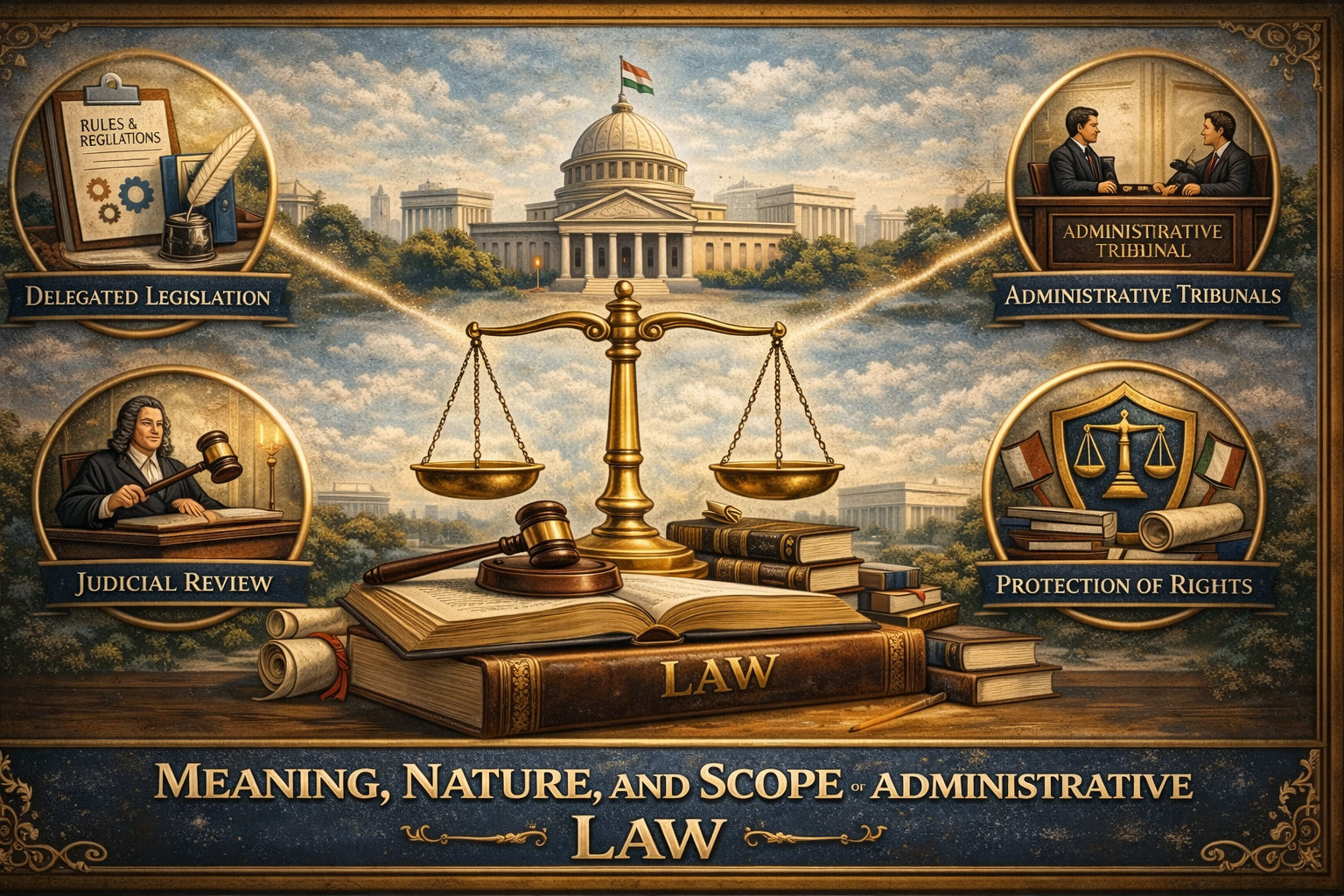
I. Legislative Powers of Administration (Delegated Legislation)
The Parliament doesn't have the time or technical expertise to draft every minute detail of a law. Therefore, it delegates the power to make "rules and regulations" to administrative authorities. Administrative law studies how this power is delegated and ensures it doesn't become "excessive delegation."
II. Adjudicatory Powers (Administrative Tribunals)
Today, many disputes are decided not by civil courts, but by tribunals (like the National Green Tribunal or Income Tax Appellate Tribunal). Administrative law ensures that these bodies follow the Principles of Natural Justice:
Rule against Bias (Nemo judex in causa sua).
Right to a Fair Hearing (Audi alteram partem).
III. Judicial Review of Administrative Action
This is perhaps the most critical scope. The High Courts and the Supreme Court have the power to review administrative acts through Writs (Habeas Corpus, Mandamus, Certiorari, Prohibition, and Quo-Warranto). If an officer acts Ultra Vires (beyond their power), the court can strike down that action.
4. Why Do We Need Administrative Law?
The growth of Administrative Law is a response to the "Administrative Age."
Preventing Arbitrariness: It ensures that an official doesn't act like a tyrant.
Protection of Rights: It provides a bridge between the power of the state and the liberty of the individual.
Efficiency: It allows for flexible and quick decision-making through tribunals, which is faster than traditional court litigation.
5. Landmark Principles: The Rule of Law and Separation of Powers
Administrative law in India is heavily influenced by A.V. Dicey’s Rule of Law. It insists that no man is above the law and every person, regardless of rank, is subject to the jurisdiction of ordinary courts.
While a strict Separation of Powers is impossible in a modern state (as the executive often makes rules and judges cases), Administrative Law ensures that there is a system of checks and balances so that no single branch becomes too powerful.
Conclusion
Administrative Law is the tool that balances State Power with Individual Liberty. As long as the government continues to play a role in our daily lives, Administrative Law will remain the most dynamic and essential branch of law. It ensures that the administration follows the law, respects the truth, and serves the people fairly.
Comments 0